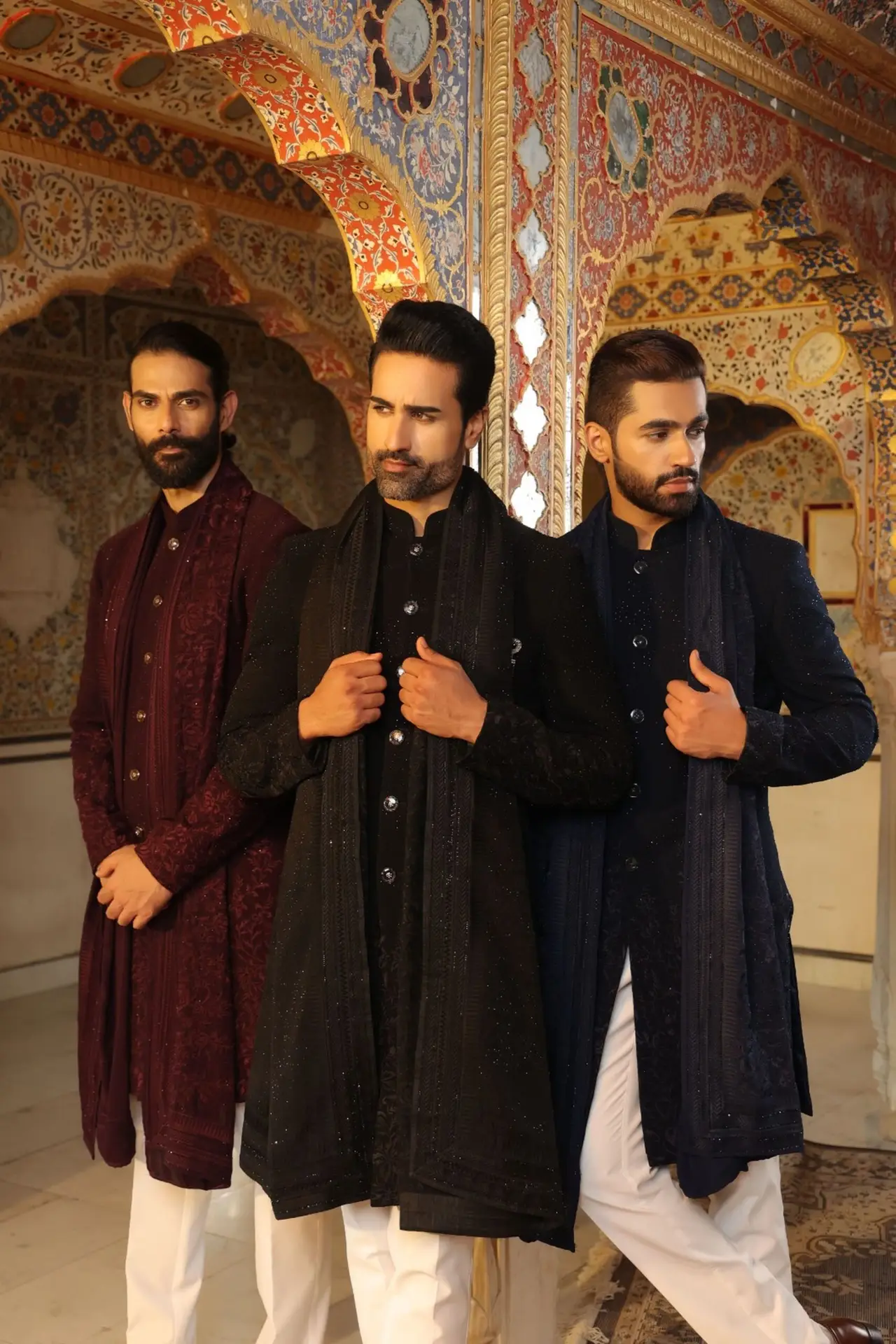
Ethnic Colour Guide for Indian Men — All Skin Tones
Some links in this article are affiliate links. If you buy through them, Varna Code may earn a small commission at no extra cost to you. Every recommendation here is based on colour science — not on what pays.
Wedding season, Diwali, a friend’s sangeet. The colour of your kurta matters more than the cut ever will — and most men default to cream or white without ever asking which cream, or which white.
I’ll be direct about my own stake in this. I’m an Indian man with Espresso skin, and for years my entire festive wardrobe was one white kurta and one black bandhgala. I wasn’t choosing. I was avoiding.
Here is what I wish someone had told me.
Came here looking for a skin tone chart? Here are the eight tones with hex codes — find your row there, then come back for what to wear.
Your white kurta is probably the wrong white
Nearly every Indian man owns a white kurta. It is the single most-owned garment in the category and the least considered, because “white” is treated as one colour.
It isn’t. There are at least three, and they behave completely differently against skin:
- Optic or bright white — cool, clean, maximum contrast. Superb on cool undertones and outstanding on deep skin, where the contrast is the entire effect
- Ivory or cream — warm white, softened with yellow. Best on warm undertones: Golden, Honey, Caramel, Mocha. On cool skin it can read slightly dingy
- Ecru, oatmeal or “natural” — muted and greyed. The riskiest of the three. On medium and deep skin it sits too close to your own depth and flattens everything
If you own one white kurta and it has never quite looked right, this is almost always why. Same garment, same fit, wrong white.
Why men get a narrower palette than the tradition offers
Walk into most menswear sections and the festive palette is six colours: cream, beige, white, black, navy, maroon.
That is a retail default, not a cultural one. Actual Indian menswear tradition is full of colour — saffron, emerald, mustard, deep teal, brick red, aubergine. Look at any wedding photograph from two generations ago and the men are wearing more colour than the men at weddings today.
You have not been given a narrow palette because it suits you. You have been given it because it is easy to stock.
Why colour matters more in ethnic wear
Western formalwear hides behind navy and black. Ethnic wear does not. Kurtas, sherwanis and bandhgalas build their entire impact around colour and embroidery, usually in large unbroken areas of fabric sitting directly against your face.
The undertone mismatch that barely registers in a plain office shirt becomes the whole outfit in festive wear. It is also why the same kurta looks superb on one friend and unremarkable on another.
Your colours, by tone
If the word you use for your own skin is “dusky”, place yourself before you pick a colour: dusky spans four of these eight tones and five different palettes. Two men who both use the word can share as few as two colours out of eight.
The numbers behind this chart are published openly. All eight tones, twenty-four palettes and 192 colour values are on GitHub as an open dataset under CC BY 4.0 — including the methodology, and a written list of what is still weak about it.
Ivory — cool undertone
Clean and cool, never warm. Navy (#1B2A4A) and Teal (#2A6B6B) carry every formal occasion you have. Raspberry (#B3446C) is the one to be braver about — pink has a long history in Indian menswear, and cool skin is the skin it was made for. Slate Blue (#6A7FA8) is the quieter everyday alternative to navy. Your neutral is Stone (#B8AC9C), and your white is optic, not cream.
Honey — warm undertone, lighter depth
Golden Yellow (#E8B33C) for haldi, Turquoise (#30A5A5) for sangeet, Coral (#E07A5F) when you want warmth without volume. Warm Cream (#F5E9D0) is your white — cream, never optic. Camel (#C19A6B) for trousers. Avoid greyed pastels; they disappear against you.
Golden — warm undertone
The easiest tone for Indian festive wear, because the traditional palette is already warm. Mustard (#C8921A), Terracotta (#C4622D) and Rust (#A03E1E) are made for you. Mossy Green (#6B7C4A) is the underused one — on warm skin, green reads considered where a third orange would read loud. Cream over optic white; Camel (#C19A6B) and chocolate for trousers.
Amber — warm undertone, mid depth
Amber is the band the standard scales skip — the middle of the range, where a great deal of Indian skin actually sits. Its palette runs close to Golden’s, because both are warm autumn: Terracotta (#C4622D), Mustard (#C8921A) and Rust (#A03E1E). Olive (#7D8C3C) and Bronze (#A67B3C) for the quieter end. If you read as between Amber and Golden, wear from both — the overlap is the answer, not a gap in it.
Caramel — warm-olive undertone
Olive undertones are common across India and almost always misread. Deep Olive (#5A6435), Aubergine (#4A2545) and Bronze (#A67B3C) look considered rather than loud — three colours almost nobody else in the room is wearing. Terracotta (#C4622D) for daytime functions, Spice Orange (#D2691E) when the light is bright. Chocolate over black.
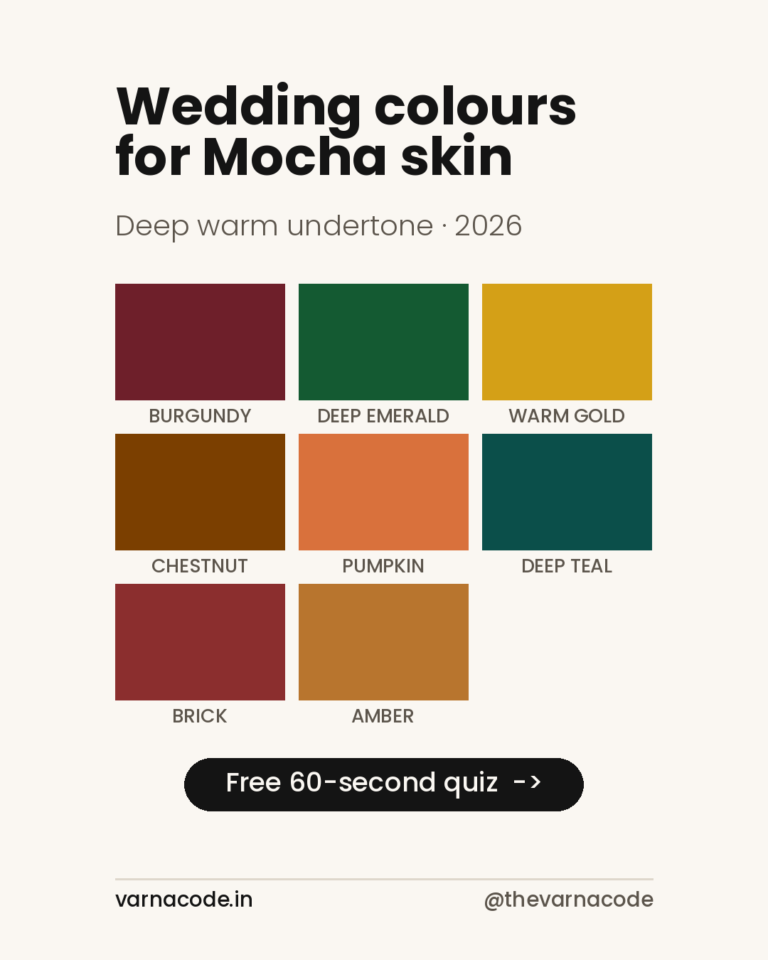
Mocha — deep warm
Saffron (#E8820C) and Gold (#C69B3C) are the two strongest wedding colours available to you — and gold is not only for embroidery. A gold kurta on mocha skin is the entire outfit. Forest (#2D5A27) for mehendi, Rust (#A03E1E) and Terracotta (#C4622D) for daytime. Skip anything dusty or washed out. Chocolate and deep olive are your neutrals, not black.
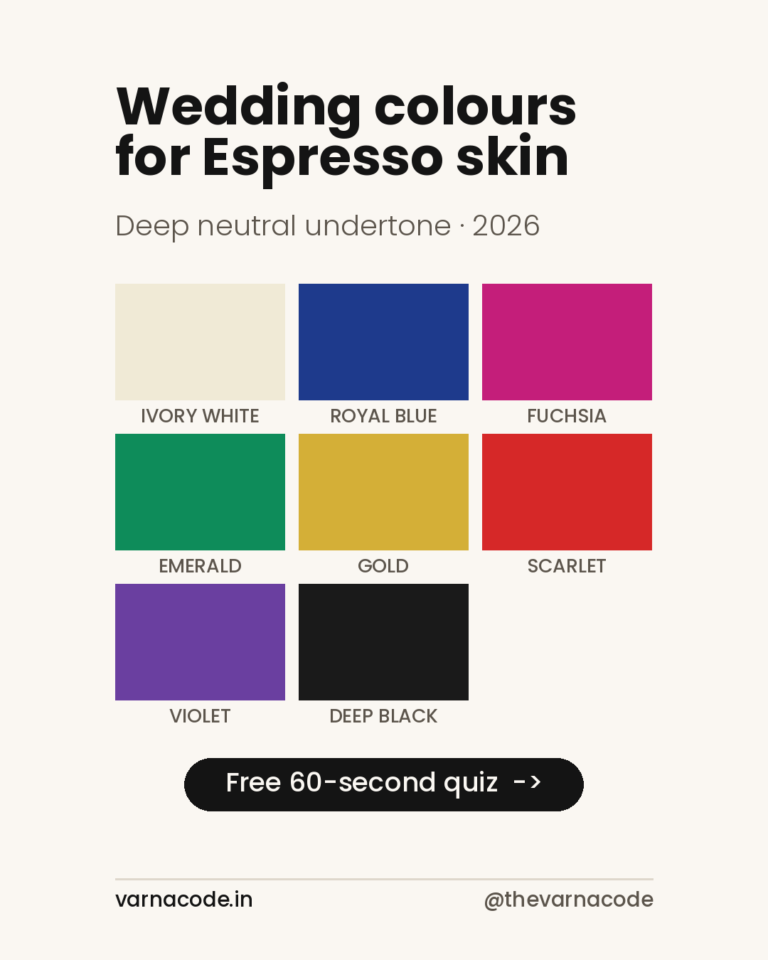
Espresso — deep
The widest palette on the chart, and the one that takes pure saturated colour without blinking. Emerald (#1B6B45), Sapphire (#1F3C88) and True Red (#C0182B) are your festive three. Indigo (#3D3580) as a bandhgala is striking and almost nobody wears it. Burgundy (#7C1D2E) for reception. Your white is a true white, and it belongs to you more than to anyone lighter — the contrast is the entire effect.
Cacao — deepest
Most charts stop a shade lighter than this and call it the bottom. It isn’t. Emerald (#1B6B45), Sapphire (#1F3C88) and True Red (#C0182B) hold their own against real depth where a muted colour would sink. Marigold (#E8A013) for haldi. Amethyst (#6C4AB0) as a jacket — almost nobody wears it, which is precisely the point. And Icy Blue (#A8C8DC), the lightest colour on the whole chart, belongs to the deepest skin, because contrast is the entire effect.
By occasion
- Haldi — yellows and marigold. Golden and Honey own this one outright. Deeper tones should go saturated rather than pale
- Mehendi — greens. Warm Moss for Honey, Deep Olive for Caramel, Deep Emerald for Mocha and Espresso
- Sangeet — the loudest permission you get. Turquoise, royal blue, scarlet, burnt orange
- Wedding day — cream, gold, ivory or burgundy depending on your tone. This is where getting the right white matters most
- Reception — bandhgala territory. Deep teal, aubergine, midnight blue over black
For a fuller breakdown of what’s trending this season and how it maps to skin tone, see 2026’s trending wedding colours.
Fabric and finish — the part that ruins good colours
A correct colour in the wrong finish still fails.
- Matte beats shine. A rich colour in matte cotton or raw silk always reads more expensive than the same colour in a shiny synthetic
- Silk deepens colour, cotton lightens it. The same emerald will read darker in silk. Buy for the light you’ll be standing in
- Brocade and heavy embroidery add visual lightness. Gold work on a deep base lifts the whole garment — which is why it has survived for centuries on Indian skin
- Avoid heavily faded or stonewashed ethnic fabric. The fade removes the chroma you need
The Nehru jacket is the cheat code
If you own one white or cream kurta and three Nehru jackets in your palette, you have four outfits and only one of them needed to fit properly.
Which colour goes on the jacket is the whole question, and there are only four kinds of answer. Bold when you want the room to notice. Rich when you want it to look expensive. Classic for anywhere the clothes should stop at competent. Suave when you would rather be the calmest man in the room. What the four names mean →
It is the cheapest way to add colour without committing to a full coloured kurta, and it puts your best colour exactly where it matters — across the chest and shoulders, next to your face.
Shop Geometric Embroidered Band Collar Kurta on Myntra
Shop Bandhani Printed Mandarin Collar Kurta on Myntra
About black
Black bandhgalas are safe and they genuinely work, particularly on Espresso skin. But an Indian wedding is the one room in the year built entirely from colour. If you turn up in black every time, you are not making a choice — you are opting out. I did this for years and have the photographs to prove it.
Common questions
Can I wear white if I have very dark skin?
Yes, and you should. Ivory and clean white are among the strongest colours available on deep skin. Just choose the right white — bright or ivory, not ecru. Shop Ivory Embroidered Kurta on Amazon
Gold or silver embroidery?
Gold for warm undertones (Golden, Honey, Caramel, Mocha). Espresso and Ivory can carry both; silver on very deep skin looks modern and is underused.
I don’t know my undertone.
Hold gold jewellery against your face, then silver. Whichever makes your skin look brighter rather than the metal is your lean. More detail in why “wheatish” isn’t a colour.
Is maroon always safe?
Close, but not always. Maroon suits warm and deep tones well. On cool Ivory skin a true red or wine works better than a brown-leaning maroon.
Get your palette before the season
Take the free 60-second quiz →, then get your Wardrobe Plan → — eight colours, ethnic and formal picks, real shopping links at your budget.
Wedding season runs October to December. Prices are best before it starts.
Varna Code
Not sure which tone is yours?
Takes 60 seconds. No selfie, no sign-up.
Take the free quiz →Launch price — first twenty
The Wardrobe Audit — ₹2,499
The quiz tells you your colours. This tells you what to do about them. You send photos of the clothes you actually wear — laid flat, in daylight, no people in the frame. I go through them against your palette and send back a written plan: what already works, what is quietly fighting your skin tone, what is missing, and a buy list ordered so the first thing you buy unlocks the most outfits.
Eight to twelve pages. Five working days. Your face is never involved — this site does not read people from photographs, and that does not change because you paid.
Opening to a small number of people first. Leave your email and I will write when a slot is free. No payment now, no obligation.
The quiz and your Wardrobe Plan stay free — always. This is the optional next step, not a paywall. Your email is only used to tell you when a slot opens.